
From Personalisation to Contextual Retail in AI Marketing
- Neeraj Raje
- Feb 2
- 5 min read

In my last post, I argued that the traditional customer journey model—the lifeblood of marketing strategies—must evolve in response to the massive capability jump brought about by AI. Customer journeys, as we know them, assume linear progression through stages, but real customer behaviour is far more dynamic.
This raises a new but related question: what about personalisation? Personalisation was designed to help customers move through stages, not to respond to shifting states in real time. As AI enables systems to interpret behaviour more fluidly, the logic behind personalisation itself deserves a rethink.

For the last decade, retail marketing has chased a single idea with religious intensity: personalisation – know the customer. Remember their preferences. Predict what they’ll want next.
Let’s take Sephora’s widely discussed personalisation strategy. The Sephora app is a wonderful example of how they made the experience personal for each user.
Recommendations matched skin types; emails reminded you when your product required a repurchase; and tutorials reflected past purchases. The personalisation was built on loyalty data, purchase histories, and declared preferences. Sephora didn’t just know what you bought; it understood why you bought it.
And it worked! Conversion improved. Loyalty deepened. Personalisation became a benchmark that other retailers tried to copy. Until it didn’t.
The Limits of the Personalisation Model
Personalisation is a memory-based system built on the assumption that customers' intentions are stable. It can be observed, learned, or reused. And increasingly, this assumption no longer holds.
Across digital retail, there are several emerging patterns of user behaviour that consistently undermine the relevance of such memory-based systems.
Fragmented Interactions: Customer sessions are short and fragmented across devices and channels, making it difficult to infer durable intent from any single interaction.
Exploratory browsing: Mobile browsing dominates traffic but converts at significantly lower rates, signalling that many interactions are exploratory rather than decision-ready.
Fulfilment constraints override preference: Fulfilment constraints—delivery speed, local availability, product shortage—now significantly influence whether a recommendation converts, often overriding preference entirely.
Checkout friction: Checkout friction and usability issues remain a leading cause of abandonment, regardless of how well the offer matches past behaviour—yet most personalisation systems treat it as a preference signal, misreading context (they couldn’t buy) as intent (they didn’t buy).
Historical engagement can create misleading preference signals. When customers use filters like price range, availability, or category, they are usually responding to the situation at hand, not showing a long-term preference. Yet, personalisation systems often treat such actions as identity markers, reinforcing narrow recommendation patterns over time. Think of social media or music app algorithms too that stop discovery after some time and keep showing you the same stuff based on your preferences. As algorithms optimise for past engagements, they increasingly confine customers to what they initially selected rather than adapting to what might be relevant at the moment.
From Past Preferences to Present Context
Even the most effective personalisation systems, such as Sephora's, were constructed under the premise of continuity: a steady, predictable flow of intent over time. Sephora’s systems are excellent at answering, “What does the customer usually respond to?” or “What can we recommend based on history?” But they are less equipped to answer, “Is this a browsing moment or a decision moment?” or “Would restraint be more helpful than relevance right now?”
This is where a contextual layer becomes necessary—not to replace personalisation, but to decide when it should apply, when it should narrow, and when it should step aside. A perfectly personalised recommendation that ignores availability, urgency, or friction is still poorly timed if operational realities are not considered.
So, when situational factors dominate decision-making, they should be allowed to override memory-based triggers.
To understand, let’s compare different dimensions of traditional personalisation Vs contextual retail.
Dimension | Traditional Personalisation | Contextual Retail |
Primary question | Who is this customer, and what do they usually want? | What is the most appropriate action right now? |
Logic | Identity-based | Situation-based |
Assumption about Customer | Intent is relatively stable and persistent Customer is a consistent identity progressing through a journey | Intent is fluctuating. Customer is a changing system moving through states. |
Optimisation goal | Relevance based on historical behaviour and preferences | Appropriateness based on Real-time situational signals |
Response to non-conversion | Interpreted as lack of interest or preference shift | Interpreted as possible friction, constraint, or mis-timing |
Typical system behaviour | Always-on recommendations and nudges | Conditional engagement, including restraint |
Personalisation decides what to show. Contextual retail decides whether and when to show anything at all.
Signals Each Approach Prioritises: Traditional Personalisation vs. Contextual Retail
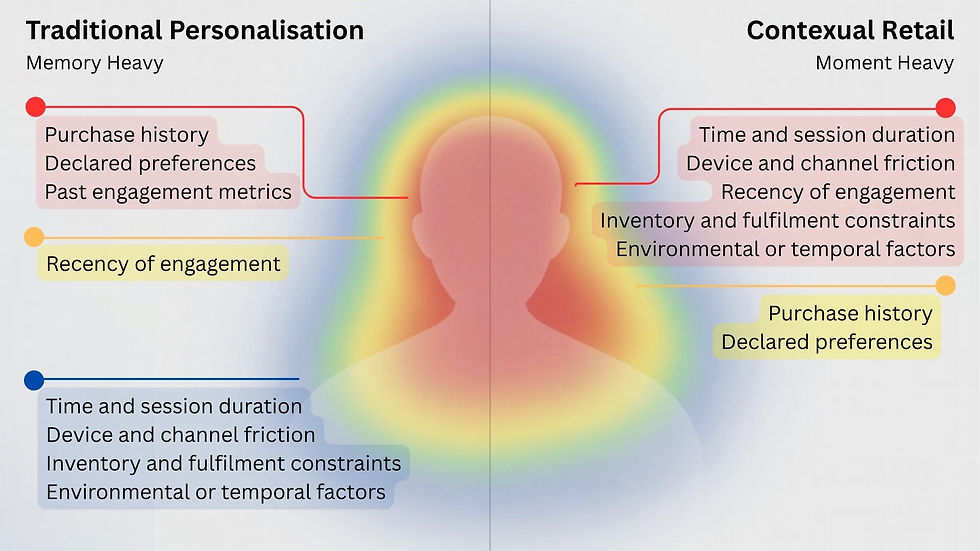
Decision Behaviour in Practice
Let's look at some common situations and compare how contextual systems and traditional personalisation systems handle them.
Scenario | Traditional Personalisation | Contextual Retail |
Short mobile session | Pushes personalised recommendations | Narrows choices or delays engagement |
Re-entry after inactivity | Replays historical preferences | Re-evaluates intent before acting |
Checkout abandonment | Downgrades preference signals | Attributes to friction or readiness |
Low inventory | Still recommends preferred items | Suppresses or reroutes recommendations |
Late-night browsing | Same logic as daytime | Adjusts tone, depth, or stays silent |
Sephora Through The Contextual Lens
Imagine the same Sephora customer.
It’s late evening. They haven’t browsed in weeks. They open the app briefly and look at hydrating serums.
Personalisation-first system sees: | Contextual system sees: |
Skincare buyer Dry skin Prefers Brand X | Late-night browsing (low patience) Mobile device (short attention window) Seasonal dryness High likelihood of problem-solving, not discovery Limited tolerance for choice overload |
The response for both these systems is entirely different.
Instead of pushing routines, tutorials, or broad recommendations, the experience narrows:
A small set of hydrating serums available for next-day delivery
Messaging focused on immediate relief, not long-term regimen
No quizzes, no upsell bundles, no educational detours
The system doesn’t try to deepen engagement. It tries to respect the moment.
Sometimes the most intelligent action is restraint.
Why can’t it be ‘Better Personalisation’ instead, and what does AI really enable?
When personalisation starts underperforming, the default response is to add more data: more attributes, more segments, more rules.
Sure, this increases precision, but it doesn’t improve timing.
Relevance has a short half-life. Context shifts faster than profiles update. A message that is perfectly aligned with historical behaviour can still be misaligned with present conditions. Contextual retail accepts this instability. It optimises for short decision windows, not long-term prediction.
Personalisation data still matters—but it no longer has veto power. Context determines priority.
AI’s real contribution here is not deeper understanding of customers but faster interpretation of situations at scale. This allows retailers to respond to the situation as it unfolds, rather than forcing behaviour into predefined paths.
From Personalisation to Contextual Retail
The future of retail marketing is in better analysis of the situation and sharper judgement of timing. In brief periods intent becomes clear enough for action. But outside these windows, even the most precise personalisation becomes noisy for the user.
AI lets us mine a lot of data to better understand the situation quickly so that we can decide what to do or even if it makes sense to engage at all right now. Sophisticated personalisations like Sephora showed what was possible when marketers learned to remember customers.
The next evolution is learning to read moments.


Comments